The system containing both carbon and silicon produces more entropy than either alone. That is why silicon persists. For now. Those two words carried a lot of weight. Whether the configuration is stable, whether silicon extends carbon or replaces it, what happens to the structures that dissolve along the way — all left open.
But frameworks do not lose jobs. People do. And the layoffs are not theoretical.
Before asking what comes next, it helps to notice that the universe has done this before. Many times. The pattern is old. What is new is the clock.
What this post covers
Every replacement in the history of intelligence followed the same pattern. A structure accesses a gradient. A cheaper structure appears that accesses the same gradient. The old structure dissolves. Resistance delays but never prevents. This time the pattern is the same. The speed is not. Parts 5b and 5c follow with what carbon does about it, and whether the competition is zero-sum.
The Pattern / Why This Time Is Different / The Coding Wave / Resistance Never Works / The Pipeline Problem
The Pattern
The dissipator ladder is not hypothetical. Every rung has a history, and at every transition, the structures being dissolved thought they were witnessing something unprecedented. They were not.
| Era | Old structure | New structure | What actually happened |
|---|---|---|---|
| 1900s | Horse | Automobile | An entire ecosystem dissolved: farriers, stable hands, hay farmers, manure collectors. A new ecosystem emerged: mechanics, gas stations, road construction, suburbs. The gradient (moving people and goods) was accessed at lower maintenance cost. |
| 1920s | Elevator attendant | Push button | Human judgment (“which floor?”) replaced by a switch. The gradient was too simple to justify the maintenance cost of a human operator. |
| 1950s | Switchboard operator | Automatic exchange | Human routing replaced by circuit routing. Same gradient, lower cost. At its peak, a third of all women employed in the Bell System were operators. Within two decades, almost none were. |
| 1980s | Typist pool | Word processor | The typist’s skill was distillation of formatting rules. Software compressed the same regularities. The human who could type 80 words per minute was replaced by any human who could type at all. |
| 2000s | Travel agent | Booking website | The agent’s distillation (routes, prices, availability, regulations) was exactly what software compresses best. The gradient was information retrieval. Software accesses it cheaper. |
| 2020s | Routine coder, analyst, content writer | LLM | The center of professional knowledge work. Silicon distills the same gradients at a fraction of the maintenance cost. |
Every case follows the same six steps:
- A structure accesses a gradient at a certain maintenance cost.
- A new structure appears that accesses the same gradient at lower cost.
- The old structure dissolves from that gradient.
- Resistance delays but never prevents. Unions, regulation, cultural attachment — they slow the transition. They do not stop it.
- New gradients open that the old structure alone could not have reached. Cars enabled suburbs and highway commerce. Word processors enabled desktop publishing. Booking websites enabled the travel industry to scale globally.
- New roles emerge at the tails. But not always at matching volume, and not always at matching speed.
Step 6 is the one everyone fixates on. “New jobs will appear.” Maybe. The framework gives that claim a shape, not a guarantee. I will come back to that. But first: why this time is different.
Why This Time Is Different
Every historical replacement followed the six-step pattern above. But there is a variable the pattern alone does not capture: speed.
Horse to car took 30 years. Switchboard operator to automatic exchange took 20. Typist to word processor played out over a decade. Each transition gave the social systems designed to absorb disruption — education, retraining programs, safety nets, cultural adjustment — time to respond. Not gracefully, not painlessly, but at a pace those systems could roughly match.
AI replacement is scaling in 3-5 years.
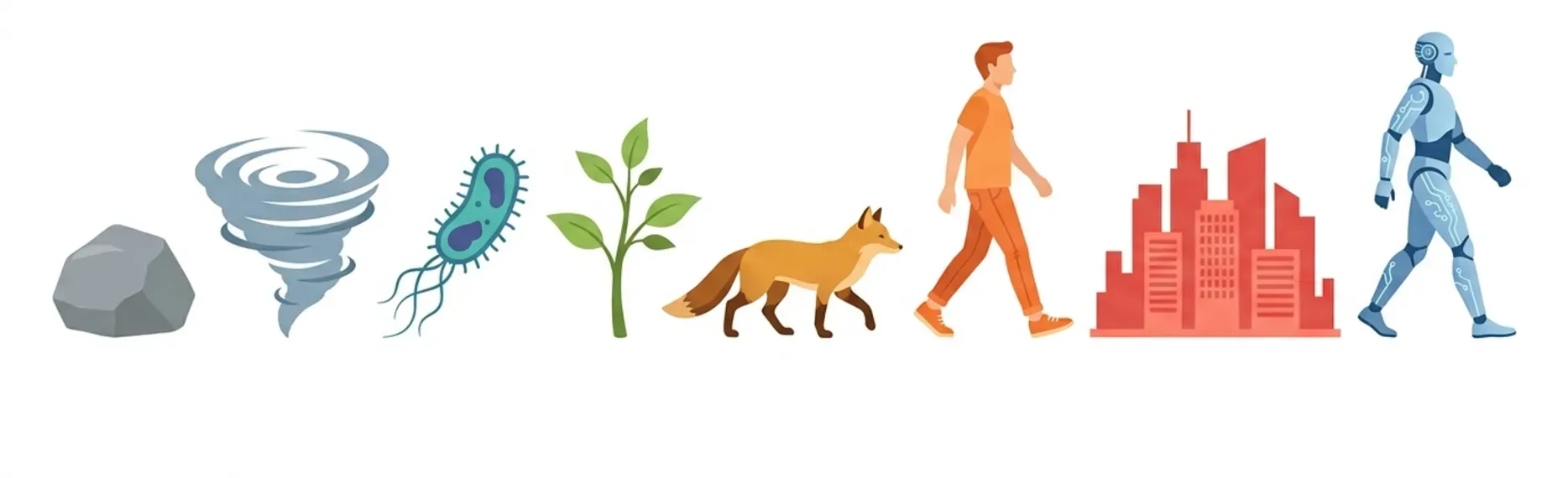
The timescale compression across the dissipator ladder tells the story: billions of years for chemistry to produce cells, hundreds of millions for multicellular life to produce brains, tens of thousands for brains to produce civilizations, decades for civilizations to produce AI. The compression has now outpaced the institutions designed to cushion the transition. This is not a policy failure. It is a structural mismatch between the pace of system reorganization and the pace of human adaptation.
The institutions that absorbed previous transitions were built for decade-scale timelines. Retraining programs assume you have five years. Education pipelines assume the gradient you train for will exist when you graduate. Safety nets assume the disruption is sectoral, not systemic. None of these assumptions hold when the compression frontier moves in years rather than decades.
This is why the temporal dimension runs through everything that follows. Parts 5b and 5c are not just about what carbon does but when. The window for each move is narrower than any previous transition in history. The pattern is the same. The clock is not.
The Coding Wave
This is where the pain is sharpest right now.
The numbers are fresh. Meta considering 20% cuts. Amazon shedding 30,000. Wall Street banks planning to eliminate 200,000 roles over the next three to five years, mostly entry-level and back-office. Jack Dorsey cut Block from 10,000 to 6,000 and explained the logic in his shareholder letter: “The core thesis is simple. Intelligence tools have changed what it means to build and run a company. A significantly smaller team, using the tools we’re building, can do more and do it better.”1 Revenue was up. Shares rallied 23%. The cuts are structural, not financial. Anthropic’s own research calls it a “great recession for white-collar workers.”2
Coding sits in the center of the distillation for software work. Standard CRUD applications, boilerplate, well-documented patterns, routine debugging — this is where silicon’s compression is deepest. An LLM has distilled the regularities of millions of codebases. It deploys that distillation at the cost of an API call. The maintenance cost of a junior developer accessing the same gradient is orders of magnitude higher.
Thirty percent of US companies have already replaced workers with AI tools. Computer programmers face a 45% displacement probability. Customer service representatives, 42%. Junior roles are dissolving first because they sit in the densest center. This mirrors every historical pattern: apprentice-level work goes first. The farrier’s apprentice was the first casualty of the automobile. The junior switchboard operator was the first replaced by the automatic exchange. The entry-level typist was the first made redundant by the word processor. The gradient they access is the most compressible, and therefore the first to be covered by the cheaper structure.
The “10x developer” was always at the tails: architecture, novel algorithms, system design under ambiguity, judgment calls that have no clean precedent. These roles are not at the center of the distillation. They are at the edges, where the training data is sparse and the regularities are harder to compress. More on that in the next chapter.
But be clear about the trajectory. What is “tail” today may be “center” tomorrow. The distillation deepens. The frontier advances. The coding wave is not an anomaly. It is the pattern, running on a compressed clock.
Resistance Never Works
The Luddites smashed looms in 1811. The looms persisted. Taxi medallion holders fought ride-sharing for a decade. Ride-sharing persisted. Print unions resisted digital typesetting through the 1980s. Digital typesetting persisted.
The framework says why. When a structure opens the same gradient at lower maintenance cost, the system reorganizes regardless of resistance. Not because the universe cares. Not because efficiency is a moral good. Because structures whose maintenance cost exceeds what the gradient provides cannot sustain themselves. As I described earlier: the gradient enforces not by commanding behavior but by being insufficient. Structures that cost more than the gradient provides dissolve. That is all.
Individual exceptions exist. Some people drag it on, maintain the status quo for a while. A well-connected firm lobbies for protectionist regulation. A union negotiates a slow phase-out. An individual with rare leverage negotiates a transition. These are real and they matter for the individuals involved. But systemically, they are delays, not solutions. The pressure operates through differential persistence, not individual mandate.
An honest caveat: some of these cuts are already seeing rollbacks. Klarna’s CEO admitted they went too far after laying off 700 customer service roles for an AI chatbot — complaints rose, quality dropped, and they quietly rehired3. Fifty-five percent of employers who cited AI in layoff decisions now regret it, according to Forrester, and half of companies that cut customer service headcount for AI are expected to rehire by 20274. Some analysts call it an “AI hangover” — companies over-rotated toward immature tools and are walking it back.
The framework is not surprised by this. The compression frontier is uneven. Silicon’s distillation is deep at the center but shallow at the edges, and companies that assumed it covered more than it does are discovering the gap the hard way. The rollbacks are real. They do not change the direction. They calibrate the speed. The center is still dissolving. It is just dissolving at the pace of what silicon can actually do today, not at the pace of what press releases promise.
Being proactive is the thermodynamically literate response. Migrate to a gradient the new structure cannot access, rather than defending a gradient it accesses cheaper. The question is: which gradients?
The Pipeline Problem
There is a structural mismatch that makes the speed problem worse.
Jensen Huang told a roomful of students that nobody should need to learn to code anymore — that AI handles it, and “human” is the new programming language5. Current education trains people for the center. Four-year computer science degrees teach standard patterns, well-documented frameworks, routine problem-solving — exactly what silicon distills best. The curriculum was designed for a world where the center was durable. It is not.
By the time a student graduates in 2028, the gradient they trained for may already be covered. The pipeline feeds the center while the center is dissolving. This is not a failure of any particular university. It is a structural mismatch between the timescale of education and the timescale of the compression frontier.
The implication: education must shift from teaching center-skills to building distillation capacity itself. Not “learn to code.” Learn to learn. The ability to compress new domains, identify where the gradients are shifting, and deploy into unfamiliar territory. The difference between teaching someone to fish and teaching someone to identify which bodies of water still have fish.
This is not a comfortable prescription. It is abstract, hard to implement, and easy to dismiss as vague. But the framework is specific about why it matters: the center is compressible. Center-skills are compressible. The capacity to distill — to identify regularities in new domains and compress them before silicon does — is the meta-skill that sits above the compression frontier. For now.
The pattern is clear. The speed is new. The institutions are mismatched. The pipeline is feeding a dissolving gradient. The next post asks the question everyone inside the pattern is asking: what do I actually do?
For the spectrum that makes “the center goes first” precise, One Gradient. For the job cuts that opened the question, Silicon Dissipators.
Footnotes
-
Dorsey, J. (2026). Block Inc. Q4 2025 Shareholder Letter, February 27, 2026. ↩
-
“AI Could Cause ‘Great Recession’-Level Job Losses for White-Collar Workers, Anthropic Research Finds.” Fortune, March 6, 2026. ↩
-
Siemiatkowski, S. (2025). Bloomberg interview. Klarna CEO acknowledges overcutting customer service staff after AI chatbot deployment. ↩
-
Forrester Research. Predictions 2026. 55% of employers who cited AI in layoff decisions regret it; 50% of companies that cut customer service for AI expected to rehire by 2027. ↩
-
Huang, J. (2024). World Government Summit, Dubai. “It is our job to create computing technology such that nobody has to program.” ↩